
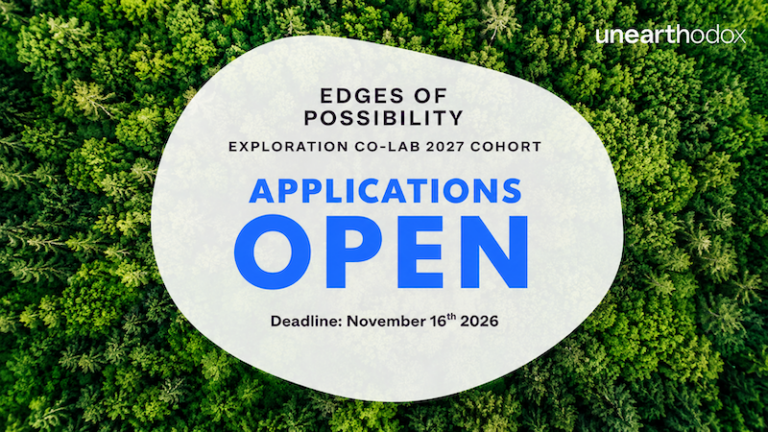
Deadline: November 16, 2026
Are you developing an innovative solution to environmental and societal challenges and looking for funding and support to take your work further? Applications are now open for the Unearthodox’s Exploration Co-Lab 2027: Edges of Possibility, a 10-month online incubation programme for innovators working to transform the relationship between people, society and nature.

Selected participants will receive a CHF 10,000 grant, tailored coaching and expert support, peer learning, systems mapping and futures-thinking support, strategic positioning, and access to a global community of systems innovators.
The programme is particularly interested in early-stage initiatives that go beyond addressing the symptoms of environmental and social problems to tackle their underlying systems and root causes. This could include work related to climate change, biodiversity, habitat loss, regeneration, environmental justice, or other challenges arising from the relationship between human societies and natural systems.
Unearthodox describes the Exploration Co-Lab as an alternative incubator for “edge-walkers”: innovators with an ambition for all life on Earth to thrive, but whose work does not necessarily fit into conventional categories.
Benefits
- Grant funding: CHF 10,000 to help move your initiative forward.
- A 10-month incubation journey: Beginning in March 2027, you will join a cohort of changemakers in an online environment dedicated to systemic transformation, connection, and changemaker wellbeing.
- Access to a shared pool of up to an estimated CHF 60,000 in value of non-financial, tailored support, including: Peer learning and shared exploration, uncovering new pathways for change; individualised coaching and expert guidance; practical systems mapping and futures thinking; strategic positioning for yourself and your initiative; regenerative approaches to define and measure success.
- Visibility and amplification: Your work will be showcased through Unearthodox’s communication channels, helping you to become more visible, findable and fundable.
- Community and collaboration: They practice deep allyship, connecting you with a global network of systems innovators, mentors, and network weavers for belonging, mutual support, and collaboration.
Eligibility
Applicants should:
- Be working on an early-stage initiative addressing both environmental and societal change.
- Be beyond the idea stage, with some initial research, testing, a pilot, proof of concept, or active community engagement already underway.
- Be interested in addressing root causes and contributing to systemic change rather than only treating symptoms.
- Be willing to participate in a collaborative, cohort-based learning experience conducted in English.
This call is for you if:
- You are working on an early-stage initiative at the intersection of environmental and societal change. You don’t need to have everything figured out, but you do need to be past the idea stage. There should be some groundwork laid, whether that’s initial research and testing, a pilot, or active community engagement. A concept on paper alone isn’t quite enough for this call.
- You might be in one of these phases:
- Testing: Likely with minimal resources, you are learning what works and what doesn’t by engaging directly with the people, environment or living systems you’re meant to serve.
- Proving: You have a tangible proof of concept that demonstrates the core idea can work, and you need funding to keep testing, refining, and building momentum.
- Deepening: You have begun to see what your initiative can make possible, and you’re ready to deepen the work by adapting your approach or exploring new pathways.
- Pivoting: You might be leading a more established initiative that requires a meaningful shift in direction, approach, or model.
- Or, somewhere between these phases. If you’re unsure which description fits, lean toward the one that best describes your current activity and mention it in your application.
If this sounds like you, even if your journey has been quiet, messy, internal, or nonlinear until now, you are invited to apply.
They especially welcome underrepresented voices from the global majority and historically excluded communities, and they embrace diversity across age, gender identity, location, and background. As a Swiss-founded organisation, they also aspire to deepen exchange between Swiss and global innovators working on regeneration. To this end, they aim to include at least one Swiss-based initiative in each annual cohort, selected on the strength and relevance of its work alongside all others.
What Kind of Initiatives Are They Looking For?
Nature-society challenges arise from how human societies and natural systems interact. This can show up in a variety of ways, from climate change to biodiversity or habitat loss. They’re looking for initiatives that reimagine what’s possible at this intersection, creating space for thriving living systems for both the natural world and the people within it.
To help you reflect on whether your work fits this open call, consider the following:
- What future is your idea helping us to push towards? And away from?
- How does it encourage people to see, act, connect, or live in new ways in relation to the more-than-human world?
- How does it challenge current systems and norms, to help all life on Earth thrive together?
- What conditions might this work need in order to flourish?
- What deeper purpose connects you and others working in this space, on this type of problem?
The Exploration Co-Lab is built on a foundation of regeneration, justice, and deep systems change. To honour this commitment, they are not looking for projects that:
- Reinforce extractive or dominant systems.
- Prioritise profit, speed, or growth above purpose.
- Address surface-level symptoms rather than root causes.
- Seek individual advantage without a genuine interest in collective learning and allyship.
Application
Before you begin, take a moment to review their website for the full application form preview, eligibility and evaluation criteria, frequently asked questions, terms and conditions, and tips they compiled after reviewing last year’s applications.
Click here to apply. Applications are open from 15 September to 16 November 2026.
For more information, visit Unearthodox.
