
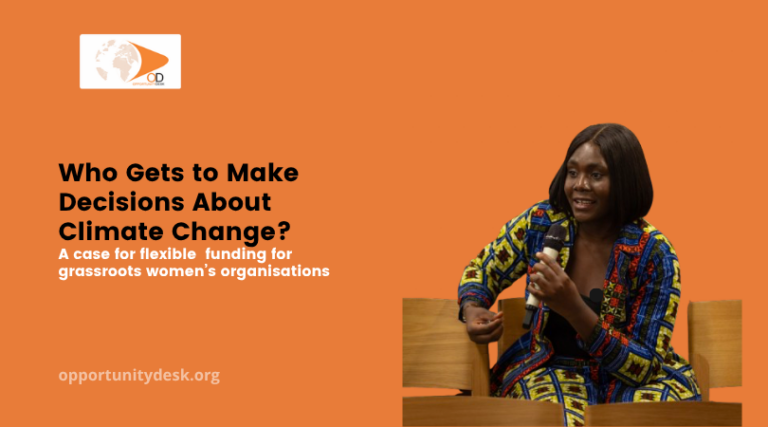
A Case for Flexible funding for grassroots women’s organisations
The generator that wouldn’t keep quiet
The office was sweltering and the generator was at it again, its diesel engine clattering in a steady, guttural clug clug, the occasional high whine making conversation impossible. At Her Voice Foundation, the organisation I started in Nigeria to support young mothers and at risk girls, electricity is supposed to help us work. That day it made work harder, diesel fumes filled the room, and the constant clatter made it hard to focus; we had to raise our voices to be heard. It cost about $15 a day in fuel, money that could have paid exam fees, textbooks, or transport for a girl trying to stay in school. A solar system that would run our office reliably cost roughly $3,500. It would pay back over time, but upfront capital was beyond our reach on short term, restricted grants. This is where climate decisions happen for many organisations, in budget lines, fuel versus school fees, rent versus program materials.

A Twelve-Year-Old Mother in a Heating World
Early in this work I met a twelve year old mother. School was gone. Marriage had come too early. There was a baby and little prospect of returning to class. Globally, 122 million children and young people are out of school (UNESCO 2023), and girls are disproportionately affected in regions such as West and Central Africa (UNESCO 2022). When money tightens, education is often the first thing cut; early marriage becomes a coping strategy. Her Voice Foundation pays fees, creates safe study spaces, provides counselling, and supplies reliable light so girls can study in the evening. The $15 we spent daily on diesel wasn’t an abstract line item, it meant missed terms, evenings without homework, and shrinking opportunities.
How money moves and what gets lost
Pledges for climate action and gender equality are frequent. UN guidance links gender equality, SDG 5, to other development goals (UN Women 2018). But most funding flows through large intermediaries; grassroots groups receive very little core, flexible support.
Less than 1 percent of gender focused official development assistance goes directly to women’s rights organisations (AWID 2019), and climate finance reaches women led grassroots groups even less (OECD 2022).
AWID & OEDC
The issue is not just the amount, it is how funds are structured. Grants often cover workshops or short term activities while excluding operational costs and capital investment. You can get money to hold a training on resilience but not to buy solar panels or pay rent. Frontline organisations therefore keep improvising, prioritising immediate survival over long term, cost saving investments.
What flexible funding let us do
Flexible funding trusts local organisations to use funds where they matter most.
In 2024, Her Voice Foundation received flexible support and installed solar panels. There was no press release, just a team relieved to stop breathing fumes and shouting over an engine. The changes were practical and immediate. The office was quieter, the air no longer smelled of diesel, staff were less exhausted at day’s end. The money we had been spending on fuel went back into programs, exam fees, textbooks, transport stipends and running costs for safe study spaces. Those are direct gains for the girls we serve. The panels didn’t make headlines, but they changed daily realities.
Climate as everyday experience
For many women and girls, climate impacts are material, not abstract, it is heat in crowded markets, sleepless nights when power fails, longer walks for water during droughts, and extra caregiving after floods. Diesel exhaust and constant noise are health hazards. The World Health Organization links air pollution and noise exposure to respiratory and cardiovascular disease and to chronic stress (WHO 2021). Those effects reduce women’s time and capacity for study or paid work. These pressures affect school attendance, concentration, and staff retention in community organisations. They shape household decisions under pressure and too often those decisions erode long term resilience.
Decision making and power
Saying “climate affects everyone” hides how power shapes options. A household cooking with charcoal cannot choose like a company that extracts oil. The fuel receipt on our desk is a small example of a broader imbalance, who spends, who decides, and who benefits. When most climate and gender funding passes through big institutions, frontline organisations stay dependent on restrictive grants. That keeps decision making distant from people who know local needs best and sidelines capital investments, solar, efficient stoves, water systems, that would cut costs and health harms over time.
Practical recommendations
If donors and policymakers want climate finance to deliver results on the ground, they must change how they fund. Five practical steps would help:
1. Direct a portion of climate and gender related funding, for example 10 percent, to women led grassroots organisations as core, flexible support, with simplified applications and reporting.
2. Allow capital investments, solar systems, efficient cooking solutions, basic infrastructure, within gender and climate program streams, recognizing their long term cost effectiveness and health benefits.
3. Offer multi year funding, three to five years, so organisations can plan, build capacity, and deliver lasting outcomes.
4. Create direct access pathways for grassroots groups into climate finance mechanisms and reduce intermediary layers that dilute funds and add conditionality.
5. Fund monitoring that centers local indicators, school attendance, reduced fuel spending, improved staff health, alongside standard output metrics. These steps would cut administrative burdens, enable cost saving investments, and keep decision making near affected communities.
So who really decides?
Decisions about climate and daily survival are made at kitchen tables, in classrooms, and at office desks, not only in conference rooms. If donors and policymakers want different outcomes, they must shift money and authority toward the people living these problems. Trust local leadership with flexible, multi year funding. Allow capital investments that cut recurring costs and health harms. Create direct access to finance for women led grassroots groups and simplify reporting. Funders who do this will see immediate returns: fewer resources spent on fuel, more spent on school fees and learning, healthier staff, and girls staying in school longer. That is how climate justice becomes practical, measurable, and sustained. When solar meets second chances, communities stop burning tomorrow to pay for today, and the people closest to the problem get to decide the solution.”
It’s the little things citizens do. That’s what will make the difference. My little thing is planting trees.
Wangari Maathai
What is your little thing?
Thanks to the Mastercard Foundation and the University of Edinburgh for convening the Climate Leadership Summit, where I first shared these reflections under the theme: “When Solar Meets Second Chances: How a Grassroots Women’s Organisation Is Saving Costs and the Planet.”
For more articles, visit OD Blog
