
Deadline: August 17, 2026
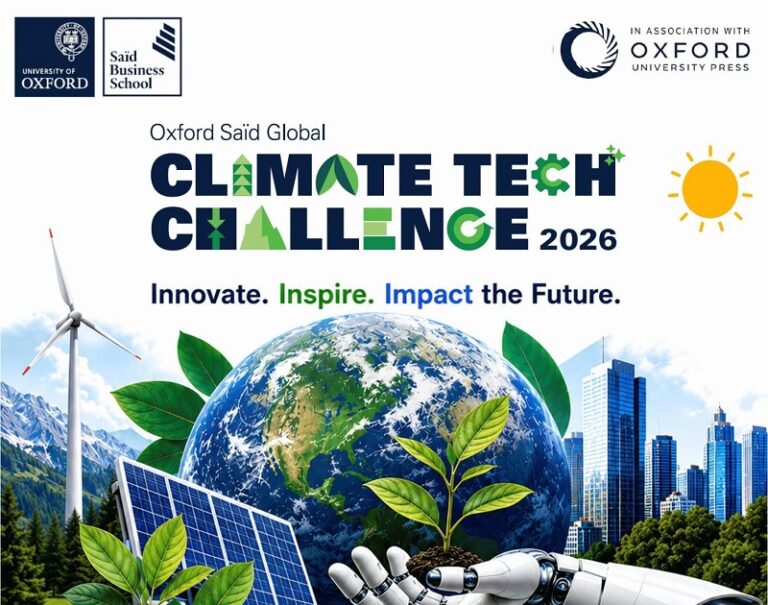
Applications are open for the Oxford Saïd Global Climate Tech Challenge 2026. Step onto a global stage and turn a climate idea into action. They invite high school students and teachers worldwide to use technology to tackle the climate crisis with bold, practical solutions.

Presented by Saïd Business School, University of Oxford, this competition empowers young innovators and educators to design tech‑driven ideas that address one of humanity’s greatest challenges and to present them at the University of Oxford.
About the Challenge
Climate change affects all life on Earth. They want to inspire high school students and teachers worldwide to use technology, creativity and problem-solving skills to generate solutions and lesson plans for the climate crisis – whether at a local, national or global level.
Entrants should respond to one of five key challenges, using technology as the foundation for their ideas and lesson plans:
- Air Pollution: Air pollution from industry and transport harms health and ecosystems worldwide.
- Imagine: What would it take to clean the air in cities or schools? Could you design systems that monitor and reduce pollution in real time? How might technology help communities breathe easier?
- Extreme Weather Events: Storms, floods, droughts, forest fires and heatwaves are becoming more frequent and severe.
- Imagine: How can we predict and prepare for these events? Could you create tools that help communities adapt or recover faster? What role could data, sensors or new materials play in building resilience?
- Food Security: Climate change threatens global food supplies and nutrition.
- Imagine: How can we grow food sustainably in changing conditions? Could you rethink farming with technology, or create systems that make food distribution fairer and smarter? What innovations could feed the world?
- Biodiversity: Species extinction and habitat loss are accelerating.
- Imagine: How can technology help protect life on Earth? Could you design tools to monitor ecosystems, restore habitats or connect people to conservation efforts? What would it take to reverse biodiversity loss?
- Water Scarcity: Climate change affects water availability, leading to droughts in some areas and floods in others. Having too little water can contribute to significant health issues, while floods can cause other health hazards.
- Imagine: How can we conserve water and manage resources more effectively? Could you develop systems for rainwater harvesting, smarter irrigation or affordable filtration for communities in need? What bold ideas could transform access to clean water?
Prizes
- Top prizes
- The winning student team will win a full scholarship to the Future Climate Innovators summer school in 2027 in Oxford, taught by Oxford University’s world renowned academics. (All expenses paid)
- The winning teacher will attend an Executive Education Programme at Oxford Saïd in Oxford, in 2027 (all expenses paid).
- Finalist prizes: All finalists will have an all-expenses paid trip to Oxford to present at the finals.
- Participation: All students and teacher who have their submissions approved will receive a certificate of participation from Saïd Business School, University of Oxford.
Eligibility
Student Teams
They want you to set out your big idea, explain your inspiration, show how you think it will make a difference and consider how your solution could be turned into a reality. Your team can include students from a single school, multiple schools, the same country or different regions.
Entries must:
- be from a team of 3-5 students aged 15-18 (individual entries will not be accepted)
- be submitted as a ten-page PowerPoint presentation (saved as PDF, ideally under 10mb)
- include a video of up to three minutes in length
- include a completed consent form for each student, signed by a parent or guardian
Teachers
They are asking high school teachers across the globe to set the agenda in the classroom with lessons that raise awareness among students about the dangers of climate change and encourage them to think creatively about solutions.
Entries must:
- be from an individual teacher (team entries will not be accepted)
- include a series of lesson plans intended for your school’s curriculum (saved as PDF, ideally under 10MB)
Judging Criteria
Student Teams
- Identifying the problem
- Research and analysis of the issue
- Level of innovation and creativity
- Feasibility and practicality of implementing your solution
- The impact and stability of solution; is it scalable?
- Clarity of presentation
- Collaboration and teamwork
- Ethical considerations and wider impact; is the approach inclusive and fair?
- Sustainability and long-term impact of the proposal
- Overall impression – professionalism, passion and commitment
Teachers
- Educational impact
- Alignment with curriculum
- Innovation and creativity
- Clarity and structure
- Engagement and student participation
- Assessment and evaluation
- Integration of technology
- Ethical considerations and stakeholder impact
- Practicality and replicability
- Overall impression
Application
For more information, visit Oxford Saïd Global Climate Tech Challenge.
