
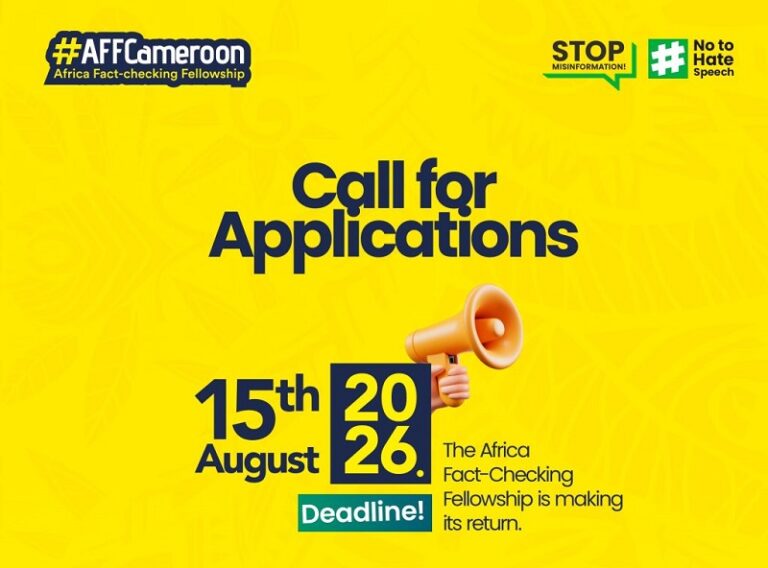
Deadline: August 15, 2026
Applications are open for the Africa Factchecking Fellowship Cameroon 2026. The Africa Factchecking Fellowship Cameroon – #AFFCameroon is a flagship program of r0g_agency and Civic Watch, which seeks to strengthen Cameroon’s information ecosystem by building a network of trained fact-checkers and information integrity defenders within the confines of the project: Protecting Civic Space Online and Offline: Countering Hate, Discrimination and Media Repression.

In the context of increasing misinformation, disinformation, hate speech, AI-generated manipulation, and Foreign Information Manipulation and Interference (FIMI), increasingly contributing to a surge in intentional policies and actions, shrinking civic space and silencing critical voices, keeps ideals like democracy and good governance under constant threat. Thus, the urgent need for efforts that ensures information verification and integrity through the Africa Fact-Checking Fellowship in Cameroon, to ensure the promotion and protection of democratic processes and freedom of expression; prerequisites for a peaceful society.
The fellowship in other words, aims at equipping fellows with practical tools to respond to evolving digital threats with special emphasis placed on elections-related information disorders, where false narratives, deep-fakes, propaganda, and coordinated influence campaigns increasingly threaten peace, democratic participation, and social cohesion.
Responsibilities
The key responsibilities of the selected Fellows will be to:
- Participate fully in all training sessions and mentorship activities.
- Produce regular fact-checking outputs and verification reports.
- Monitor assigned digital platforms and communities.
- Submit alerts on emerging misinformation threats.
- Contribute to election monitoring and rapid response efforts.
- Participate in collaborative investigations and peer learning.
- Uphold editorial ethics, neutrality, transparency and be politically impartial.
These will culminate to the realization of well-defined deliverables which are:
- Verified fact-checking reports
- Weekly misinformation/FIMI trend briefs
- Community verification alerts
- Election misinformation monitoring reports
- AI-threat case studies
- Pre-bunking and inoculation content, including anticipatory messaging, explainers, and public guidance designed to build resilience against emerging misinformation narratives before they gain traction.
- Public awareness and media literacy content to promote informed civic participation and responsible information sharing.
Benefits
Applicants at the end of the fellowship are expected to have the following but not limited to the aforementioned benefits of the fellowship program:
- Gain experience in information verification and fact checking
- Join a national network of emerging fact-checkers
- Gain knowledge on responding to election-related information threats
- Exposed to a platform that can publish produced fact-checking articles
- Open to existing opportunities in the domain of fact checking
The fellowship shall provide a monthly/quarterly stipend and other necessary logistics during the cohort period.
Eligibility
Open to:
- Journalists or media educators
- Bloggers or content creators
- Civic tech actors
- Digital/Human rights defenders
- Researchers / OSINT practitioners
- Community leaders or youth advocates
- Final year students
- Election observers and legal practitioners
- Be resident in the Northwest, West, Southwest, Littoral or Centre region
Added to the aforementioned eligibility criteria, applicants must:
- Demonstrate strong interest in fact-checking and digital rights
- Have basic digital literacy
- Accept diversity and be politically impartial
- Be active online or within communities
- Be committed to ethical information sharing and
- Be available for the full fellowship duration
Application
Interested applicants are required to submit a complete application comprising the following documents:
- A Curriculum Vitae (CV) highlighting relevant academic qualifications, professional experience, and any work related to journalism, fact-checking, digital rights, OSINT, media, research, civic engagement, or information integrity.
- Evidence of Previous Fact-Checking or Verification Work, which may include:
- Published fact-checking articles;
- Verification reports;
- Investigative or analytical publications;
- OSINT investigations;
- Relevant media content demonstrating verification skills.
Applicants without prior published fact-checks may submit other evidence demonstrating strong research, verification, or analytical capabilities.
- A Fact-Checking Project Pitch (maximum 300 words) outlining:
- A misinformation, disinformation, AI-generated manipulation, or FIMI challenge affecting Cameroon or their community;
- Why the issue is important;
- How they would investigate and verify the issue;
- The expected public value or impact of the proposed fact-checking project.
- Applicants may submit one recommendation letter from an academic institution, employer, media organization, civil society organization, or community leader attesting to their integrity, professionalism, and suitability for the fellowship. While not mandatory, a recommendation letter will be considered an added value during the selection process.
Complete applications should be submitted to [email protected] / [email protected] by August 22, 2026 at 23:59 WAT. All documents should be labelled accordingly with “Application AFFCameroon_Your Name_2026” in the subject line.
For more information, visit Africa Factchecking Fellowship Cameroon.
