
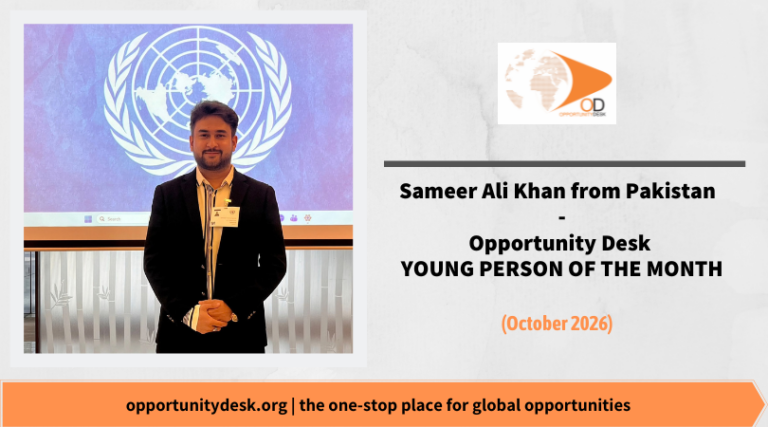
Sameer Ali Khan is a peacebuilder, climate justice advocate, and social innovator from Thatta, Sindh, Pakistan, whose work connects the realities of climate-vulnerable and marginalized communities with global conversations on peace, democracy, women’s rights, and technology.
Background and Work

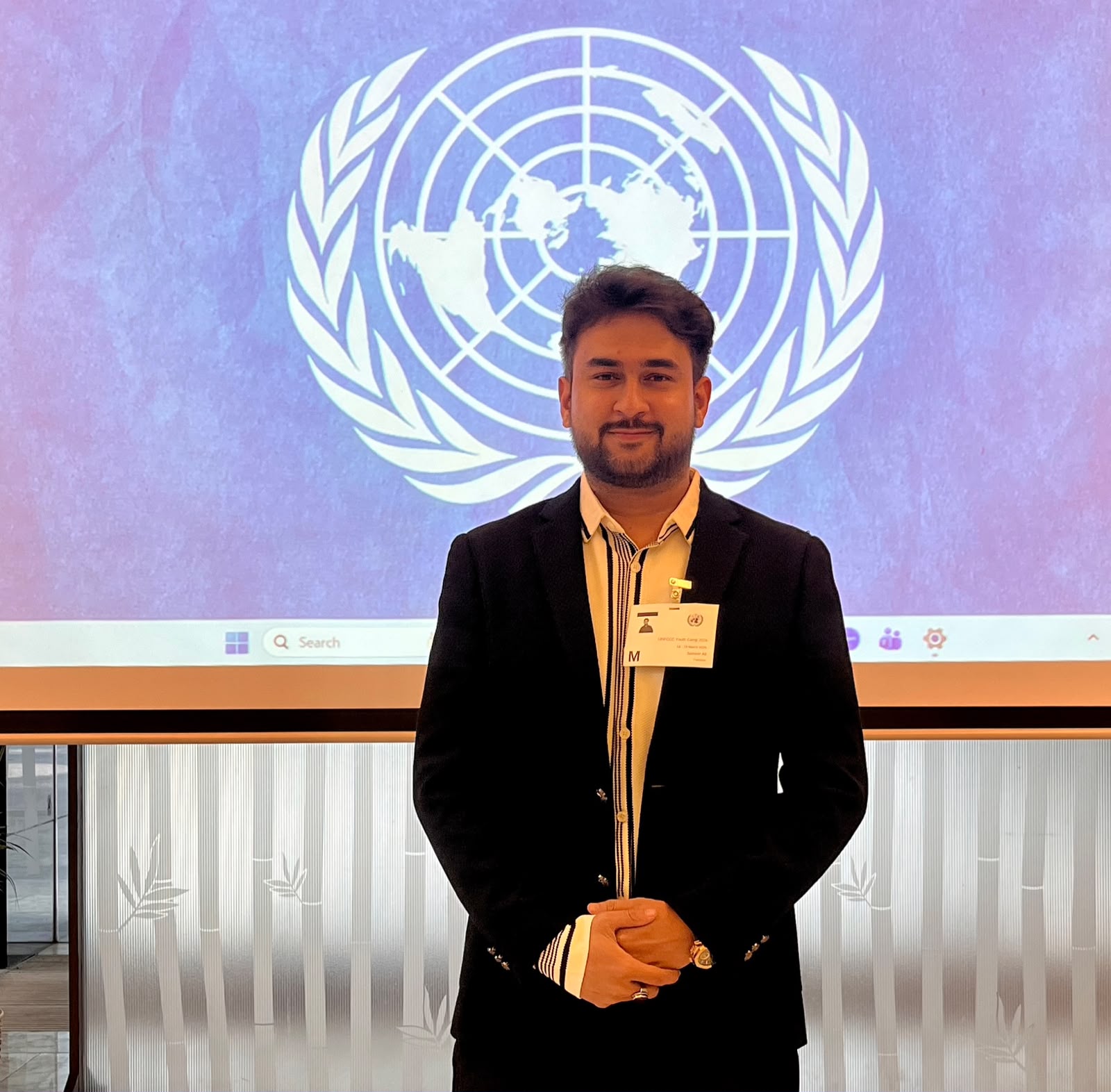
Growing up in the Indus Delta, Sameer experienced the consequences of climate vulnerability firsthand. The 2010 floods displaced his family and disrupted his education, giving him an early understanding that climate change is not only an environmental crisis it can become a crisis of peace, dignity, mobility, education, and opportunity. This experience became the foundation of his work to ensure that communities living at the margins are represented in decisions that shape their futures. Sameer is the founder of Collective Pakistan, a youth-led organization working with communities affected by climate change, conflict, discrimination, hate, and social exclusion. Under his leadership, Collective Pakistan has developed community-led initiatives across Sindh and Pakistan engaging women, young people, religious and ethnic minorities, Indigenous and climate-vulnerable communities through peacebuilding, storytelling, digital inclusion, and civic participation. His approach is rooted in a simple principle: global challenges require locally owned solutions. Rather than treating vulnerable communities only as beneficiaries, Sameer works to position them as knowledge holders, storytellers, innovators, and decision-makers.
From Peacebuilding to Climate Justice Sameer’s peacebuilding work explores how social cohesion can be strengthened in communities experiencing conflict, hate, displacement, and exclusion. Through creative peacebuilding, community dialogues, digital storytelling, and women-led initiatives, His climate justice work focuses particularly on the Indus Delta and coastal Sindh, where climate change intersects with displacement, water insecurity, livelihoods, gender inequality, and social vulnerability. His projects create spaces for women and young people to document their experiences and influence conversations about climate and community resilience. For Sameer, peace and climate justice are inseparable: there can be no sustainable peace where communities are continuously displaced, excluded from resources, or denied a meaningful role in decisions affecting their survival.
Successes So Far
A defining area of Sameer’s leadership is his work to make emerging technology useful for communities that are often excluded from the digital revolution. Through Jamhooriyat Saheliyan, he has helped develop a localized AI-powered WhatsApp solution for rural women in Sindh, enabling them to access and understand Pakistan’s Right to Information system through Sindhi, Urdu, and Roman Urdu. The initiative was designed around a fundamental democratic gap: women in rural communities may have questions about schools, health services, public schemes, and government accountability, but often lack the information, confidence, language access, or social space to ask them. Rather than asking rural women to adapt to complicated technology, Sameer’s approach adapts technology to their language, culture, literacy levels, and everyday realities. Women have been trained to identify community issues, seek public information, and file RTI applications. Sameer has also developed a digital library initiative for young girls and women, using technology to expand access to learning and awareness resources around education, rights, women’s empowerment, and issues including early child marriage. The initiative reflects his wider commitment to closing the information gap faced by girls in underserved communities. By bringing knowledge into accessible digital spaces, he seeks to create pathways for girls to understand their rights, continue learning, and imagine futures beyond the limitations imposed by poverty, gender inequality, and early marriage. Through Safar Buddies, Sameer has experimented with another form of peacebuilding: bringing people together through travel, heritage, and cultural exchange. The initiative connects young people with the cultural and religious diversity of Sindh while creating opportunities for local communities and women entrepreneurs. Across these initiatives, the common thread is connection—connecting communities across differences, connecting climate justice with peace, connecting women with information, and connecting technology with human rights.
Awards and Recognition
Sameer has taken these community experiences into international spaces focused on peacebuilding, climate justice, Indigenous and minority rights, youth leadership, digital democracy, and responsible technology. He has contributed to international dialogues and leadership initiatives and has been recognized as a Kofi Annan Changemaker. His work has also connected him with international networks working on climate, peace, youth participation, digital governance, and social innovation. What distinguishes Sameer’s leadership is the bridge he builds between lived experience and systems change. He does not approach global challenges only through policy discussions; he brings evidence, stories, and solutions from communities that are often missing from those discussions. From the villages of the Indus Delta to international policy spaces, Sameer’s work is driven by one conviction: the people living closest to the world’s most complex challenges must have the power, knowledge, and technology to help design the solutions.
You can be the next Opportunity Desk Young Person of the Month! All you have to do is get a friend to recommend your work or fill out the nomination form here. We want to use the platform to recognize and celebrate the efforts of amazing young people around the world. Oh! And you must be an active Opportunity Desk member, either as a fan, reader, or subscriber! Share!
Read about previous YPOMs here.
