
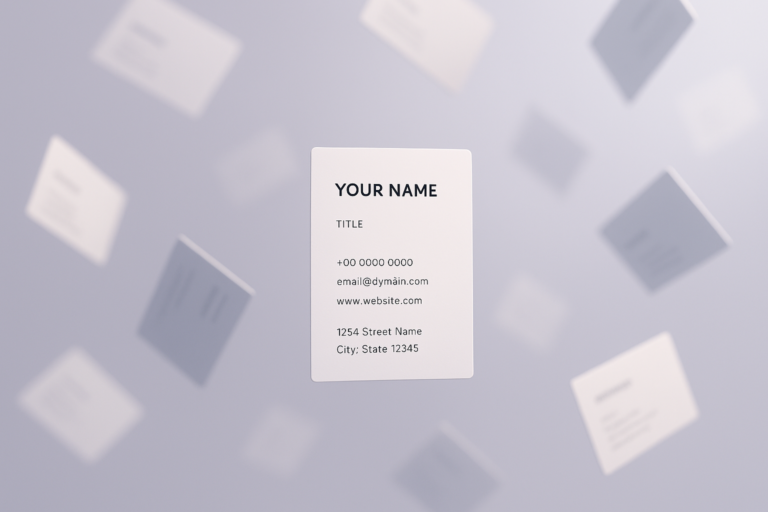
A business card might be small, but the way it’s laid out says a lot about your brand. One of the first design choices you’ll make is deciding between a vertical or horizontal layout. Each one offers a different feel — and the right choice depends on your style, message, and audience.
Luckily, with the help of AI tools, you can experiment with both designs quickly and easily — even if you’re not a designer. In this guide, we’ll walk you through the pros and cons of each format, when to use them, and how to design your card step-by-step using AI.

Why your card layout really matters
Your business card is often the first printed piece of your brand that someone sees. It communicates not just your contact info, but your personality and approach. Choosing a vertical or horizontal layout isn’t just about looks — it’s about how you want to be remembered. For small businesses and entrepreneurs, getting this choice right helps you stand out, show professionalism, and express your unique identity in a format people will actually hold in their hands.
Horizontal cards: classic, safe, and familiar
The horizontal business card is the standard format — and for good reason. It’s instantly recognizable, easy to scan, and works well with almost any industry or brand style.
Benefits of horizontal cards:
- Familiar and comfortable for most people
- Easy to organize in wallets and holders
- Great for linear layouts: logo on the left, info on the right
- More space for wide elements like emails or URLs
- Feels professional and traditional
Horizontal cards are especially useful if you want a straightforward, no-surprises presentation of your business. They’re perfect for industries like finance, law, consulting, or any brand that values stability and clarity.
Vertical cards: modern, creative, and eye-catching
Vertical layouts flip expectations — literally. They’re less common, which means they often get a second look. If you want your card to feel bold, artistic, or unconventional, this might be the layout for you.
Benefits of vertical cards:
- Unique and attention-grabbing
- Ideal for creative industries and personal brands
- Great for portrait-style designs or stacked information
- Works well with logos above the name
- Can feel more personal or informal
However, vertical cards require more careful design. Text needs to be legible in a narrow space, and traditional wallets or holders may not accommodate them as easily. Still, if your brand thrives on originality — think designers, photographers, wellness coaches, or boutiques — a vertical format might reflect your personality better than a horizontal one.
How to design both layouts using AI tools
You don’t need a design background to test both formats. Most AI-powered platforms allow you to choose vertical or horizontal layouts and preview them instantly.
Start by answering these questions:
- Do I want my brand to feel classic or unconventional?
- How much information do I need to include?
- What’s more important — structure or expression?
Once you have a direction, you can open an AI business card generator and try out different templates in both formats. You’ll see how your logo, name, and details look in each — and which one better represents your brand. Some tools (like Turbologo) let you upload your logo, auto-apply your brand colors, and switch layouts with one click. This makes it easy to experiment without starting over.
What to include — and how layout affects it
Both vertical and horizontal cards include the same basic elements. But how you arrange those elements depends on the format.
Essentials to include:
Your name and title: Centered or top-left (vertical) vs. left-aligned or top-right (horizontal)
Logo: Can go above, beside, or behind the text
Contact info: Keep it readable; avoid squeezing long emails or websites
Website or QR code: Optional, but great for modern layouts
Social media (if relevant): Use 1–2 platforms max
White space: Leave breathing room — especially on vertical designs
A good layout directs the eye naturally — top to bottom in vertical formats, and left to right in horizontal ones. That flow should match how people read and absorb your information. Vertical designs often work better when each piece of content has its own “zone.” Horizontal cards often work better when content is grouped tightly.
Tips to make the most of either layout
Whether you go vertical or horizontal, the design basics stay the same. Here’s what to focus on:
Keep text readable: Avoid fonts below 8 pt
Use contrast wisely: Dark text on light backgrounds works best
Limit your palette: Stick to 1–2 brand colors
Align elements cleanly: Avoid misaligned text or uneven spacing
Print a sample: Always test both versions before printing in bulk
Think about storage: If your clients keep cards in wallets, horizontal might fit better
Match your industry: Let your card layout reflect your field and values
If you’re unsure which layout fits your business best, try both. Design a few versions and ask for feedback from peers or clients. You might be surprised which one clicks with your audience.
Conclusion
Choosing between a vertical and horizontal business card isn’t just a design decision — it’s a branding choice. The layout you pick should reflect the personality of your business, your goals, and the way you want to show up in the world. Thanks to AI tools, you don’t have to commit to one immediately. You can try both, tweak your content, and see what fits best — all in just a few minutes.
Whether you go classic with a horizontal layout or bold with a vertical one, the key is making your card feel like you. And when you do that, people will remember you — no matter which way they hold the card.
For more articles, visit OD Blog.
